Education Articles for Teachers & Educators
Explore research-based articles on K–12 education, written by Model Teaching and guest contributors.
Our Latest Article
If you have taught for any length of time, you have probably taken a quiz that sorted you into a learning style, or watched your students take one. The idea is familiar and appealing. Some students seem to learn best by seeing, others by listening, others by reading and writing, and others by doing. This framework, often called the four types of learners or the VARK model, appears in workshops, lesson planning templates, and countless blog posts. It offers a simple promise: identify how a student learns best and teach to that style so that you can watch your student’s achievements rise. The framework is worth understanding, and there is real value in knowing your students’ preferences. But, the promise that applying learning methods or preferences in your instruction improves student outcomes is overstated and is worth delving into so that you understand the true impact of what implementing learning style preferences does in your classroom. Decades of research now tell us that matching your instruction to a student’s preferred style does not necessarily improve academic outcomes alone. This article explains what the four types of learners are, what research actually shows, and how you can use the idea of learning preferences in a way that supports your students without overpromising results.

Recent Articles

Retirement takes planning, in addition to all the hard work you have put in over your career to save and prepare for life after teaching! You already know that all the paperwork, the benefits, and the life you want to build after you retire will go more smoothly when you start your planning early. After years of retirement contributions, you can finally start envisioning life after teaching. You can use this article to help you stay on track in the year before you leave and in the months after so that you engage in a stress-free retirement from the beginning.
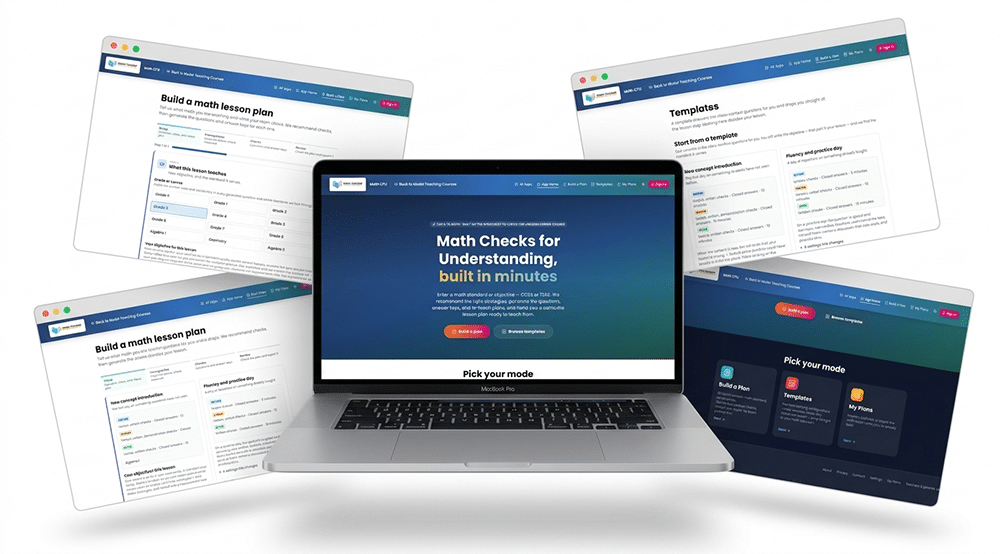
Consider this scenario. A third-grade teacher is about to begin a math lesson on finding the missing side length of a polygon when the perimeter and the other side lengths are given. She has taught perimeter over the last two days, and her lesson plan is ready. What she does not yet know is whether her students can still determine the perimeter of any object when given the length of all sides, whether they can add and subtract well enough to work with those numbers, or which two or three students will need her attention first once the new content begins. Without that information, she will find out the answers later, like in the middle of the lesson, or on the unit test, when it’s too late to help her students in the moment. Effective checks for understanding come from strategic planning, beginning with what you want to test students on and ending with data gathered from every student about what they have learned and know from the lesson. The Model Teaching Math CFU Lesson Builder is a free planning tool that helps create a detailed plan to check for understanding in a specific lesson, aligned to your lesson objective or standard.

Every fall, school and district leaders make decisions about how to spend professional development dollars. Some of that money comes from local budgets, and a large share comes from Title II, Part A, which arrives in two installments and must be spent on activities that meet the federal definition of professional development. You have many options for professional development, like conferences, workshops, in-person trainings, online trainings, coaching, and more. The difficult part for you, though, is determining which professional development activities will be the most effective for your teachers. This article gives you some ideas on what effective professional development means. In this article, you will first learn about the research on what effective professional development looks like, summarized in seven characteristics that you can use as a checklist. The second is the definition of professional development written into the Every Student Succeeds Act (ESSA), which determines whether an activity is an allowable use of federal funds. Understanding this in more detail will help you choose professional development that improves instruction and also withstands a compliance review.

New York is one of the highest-paying states for teachers in the country. According to the National Education Association, the average New York teacher salary was $98,655 in 2024-25, the second-highest salary in the nation. Salaries vary widely across the state, and one of the main ways teachers move up within their district’s schedule is by earning graduate-level credits. Nearly every New York district rewards continued coursework that advances your teaching practice by providing a permanent increase in base pay. This article explains how salary advancement works in New York and walks through examples from Buffalo, White Plains, and Pittsford so you can consider what a lane change is worth over a full career. You’ll also consider how you can maximize your salary over time, while spending the least amount toward credit accumulation, by selecting bundled credit options to satisfy your district requirements for a lane change.
-
If you lead a school, you have probably spent the past two years watching federal education funding move in ways that are difficult to plan around. Title II, Part A was held back for most of July 2025. The Elementary and Secondary School Emergency Relief funds are gone. The administration has twice proposed eliminating Title II-A, and a House committee bill would end the program for 2027-28 and rescind part of this year’s money. This makes it reasonable for you to wonder whether the professional development you planned in August is safe to schedule in October. This article walks through what has been enacted, what remains a proposal, when your money arrives, how long you have to spend it, and the three planning decisions that protect your school no matter how the next appropriations cycle ends.
-
Think about a lesson where every student in your class is responsible for one piece of the content, and no one will be able to understand the content fully unless they all work together and learn from each other. Consider one student group who have studied the causes of an event, another has studied the key figures responsible for the event, and a third has studied the consequences of that event. When these students regroup, each student becomes the source of information that they then share with their peers. To understand the entire concept for the lesson, every student has to teach one piece, and every student has to listen to the others. This is the foundation of a popular cooperative learning strategy in education: the jigsaw method. Jigsaw strategies break a topic into parts, make each student an expert in one part, and then rely on students to teach one another until the full concept comes together. But, in order for it to be actually effective and promote learning, you must consider a specific structure and planning process when implementing this into your classroom.

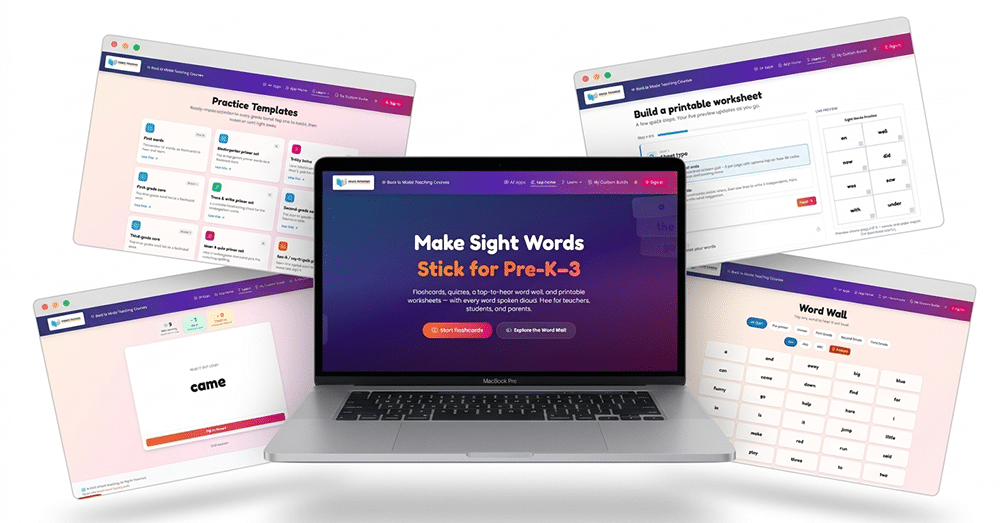
Imagine a first-grade teacher finishing a week of high-frequency word instruction. Her students had practiced the week's ten words every day, chanting them at morning meeting, tracing them on whiteboards, sorting them into a pocket chart, and nearly every child passed Friday's quiz. Then, on Monday, as she worked in a small group of students, she noticed a student who stopped at the word "said". He looked at the page, tried "sad" and "sat," and then just skipped it altogether. He got the word right last week on his quiz! The teacher's first instinct is reasonable on the outside: "he just needs more repetition and more time memorizing this word!" But the trouble she is missing is that he hasn't actually practiced decoding the word to help move the word into storage. Pure memorization alone, this teacher quickly realizes, is not the way to ensure students master sight words. This article discusses how high-frequency words become sight words, and why explicit attention to letter-sound structure is what really helps students master sight words. You'll leave this article with an understanding that sight word practice can be a necessary component of reading practice, but as a supplement to, and not a substitute for, the strong reading instruction you are doing in your classroom.
-
Think back to your own childhood as a student in school. Do you recall going on any field trips? Maybe you toured an art museum and can still picture your favorite work. Perhaps you went to a zoo or aquarium and learned about an animal you never knew existed. Maybe you watched a play or a musical performance that sparked a lasting interest in the arts. Field trips give students the chance to experience things they might not otherwise encounter in their daily lives, and they can have a lasting impact on a child's education. Read More.
-
You have likely used, or seen, teachers transform and improve behaviors using a simple sticker chart as a rewards system. You might have also seen how a student’s behavior improves after you focus on providing consistent and specific praise. Positive and negative behaviors in your classroom don’t typically come out of nowhere, and much of what your students do is actually shaped by what happens before they do it and whether the behavior is followed by something like a reward, a consequence, or a specific action. One well-studied framework for understanding student behaviors comes from B.F. Skinner’s theory of operant conditioning, which describes how what comes after the behavior is what makes that behavior more or less likely to happen. In this article, you will learn about operant conditioning and why it can be beneficial to understand in your classroom.
-
Instructional strategies are research-based methods that teachers use to deliver content to students and improve their instructional practice. But it also goes further than that, because by combining classroom management strategies, assessment strategies, and other brain-based and memory-based strategies to support students, they all work together to improve the classroom and increase learning. This article serves as a resource to understand how strong instructional and other teaching strategies translate to student success in your classroom. (Read more)
-
As a teacher plans a reading unit for her upcoming class, she decides to increase the rigor of her planned lesson activities. Since the text she chose contains many unfamiliar words, students are tasked with reading a passage, listing the unfamiliar words, and defining them using their dictionaries. She decides that instead of requiring students to choose five words to define, she will require students to define ten words this time. (Read more)
-
You can earn graduate-level credits for your Massachusetts lane change, adding thousands of dollars to your salary each year. This article will provide you with some examples of lane changes and help you think about the lowest cost path to accumulate your credits and increase your salary.